Subcontracting Tracking and ERP Database Architecture in Manufacturing Enterprises
Explore step-by-step how outsourced subcontracting operations should be modeled within the ERP database architecture in manufacturing enterprises.
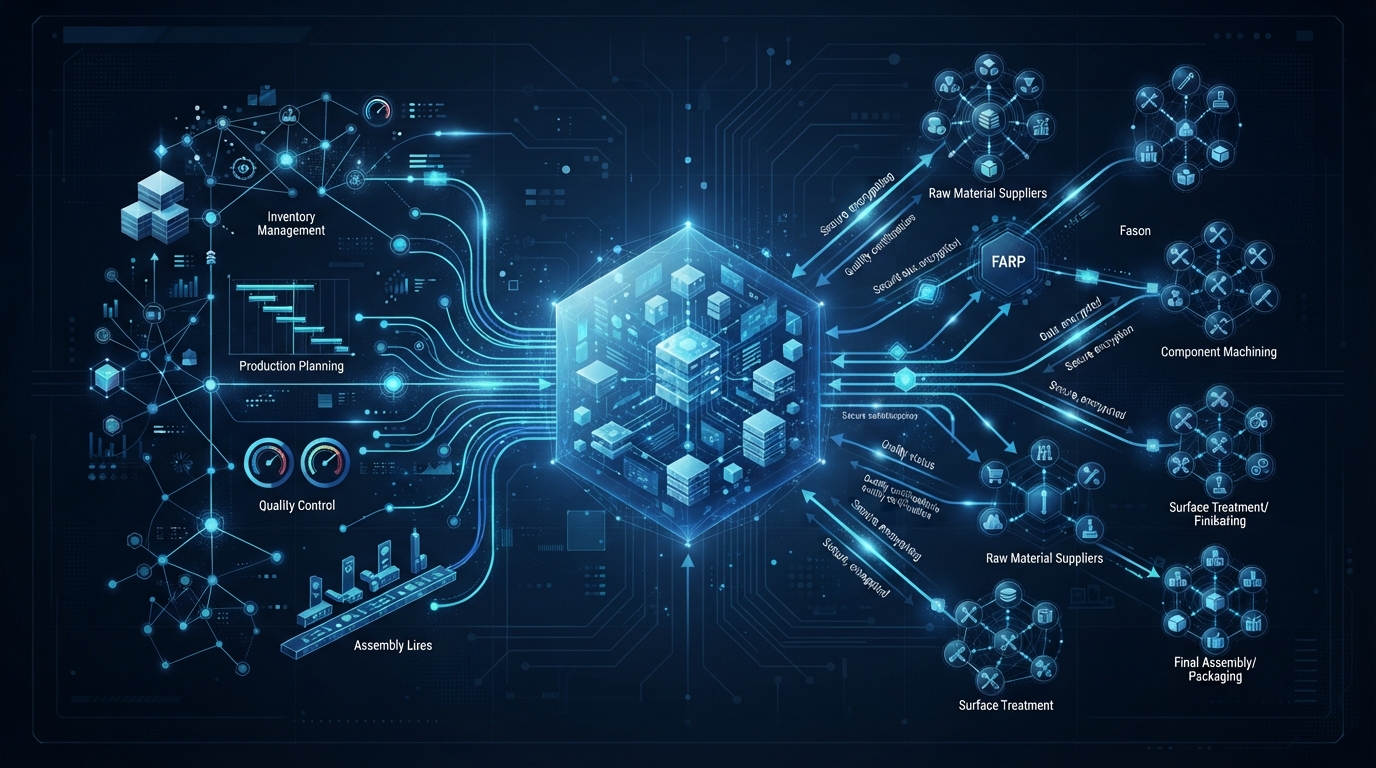
Proper management of outsourcing in production processes plays a critical role in terms of operational efficiency and financial accuracy for businesses. In the digital transformation processes of enterprises in Turkey and Northern Cyprus, multi-departmental structures must be consolidated under a single roof within the scope of Enterprise Software & ERP. In this guide, how outsourced processes should be modeled in the system is discussed with its technical details.
1. Work Order and Operation Definition
For the tracking of subcontracting processes at the database level, main work order tables must first be designed to support external operations. In the production management module, when one of the steps of a routing is determined as subcontracted, the relevant work order detail is directed to the subcontractor.
- In the work order header table (WorkOrders), whether the operation type is internal or external must be maintained with a flag field.
- In the operation detail table (OperationDetails), the current account code information and dispatch dates of the relevant subcontractor must be associated.
2. Stock Movements and Dispatch Integration
The exit of semi-finished products to be sent for subcontracting from the facility and their return after processing must be monitored meticulously in terms of stock integration. In the database architecture, this process is managed with special waybill and warehouse movement types.
- For exit movements, a subcontract exit warehouse must be defined in the
StockTransactionstable. - At the return stage, stock entry movements must be updated taking into account waste rates and scrap quantities.
3. Cost Allocation and Financial Integration
Transferring the labor and service costs brought by subcontracting operations to the main product requires an accurate cost allocation mechanism. Service invoices coming from the supplier must be integrated into the relevant work order cost accounts and general cost pools within the Enterprise Software & ERP infrastructure.
- Service invoice lines must be directly matched with the relevant work order number (WorkOrderID).
- Actual subcontract costs should be reported as a sub-item in the calculation of standard cost variances.
4. Sample Scenario: Subcontracting Tracking in Metal Processing Process
In this scenario, the metal part subcontract coating operation of a business operating in the automotive supply industry is discussed. The business sends the steel shafts processed in the main production line to an external supplier for electrostatic powder coating. The process starts with opening a new record in the WorkOrders table in the ERP system. The coating operation, which is the third step of the relevant routing, is marked as external and matched with the supplier current account code in the OperationDetails table. Steel shafts are deducted from the StockTransactions table with a subcontract dispatch note and transferred to the subcontract warehouse. When the supplier completes the operation at the facility and sends the products back, a subcontract entry note is created in the system after quality control approval. At this stage, net sound products are taken into main stock by deducting a 2% waste and scrap record. The service invoice issued by the supplier is processed into cost accounting with the WorkOrderID reference. Thanks to this setup, production costs are tracked transparently while potential variances can be reported instantly. At every stage of the process, data is kept consistent with the integration assurance provided by the Enterprise Software & ERP infrastructure.
5. Implementation and Integration Checklist
For the subcontract tracking architecture to work flawlessly at the database level and to manage potential error scenarios, certain steps must be completed fully. First, it should be verified that external operation flags and current account relationships are defined as mandatory fields in work order header and detail tables. Subcontract exit and entry warehouses must be strictly separated in stock movements, and waybill matching mechanisms should be established to prevent temporary stock discrepancies. In financial integration, triggers should be written to check whether service invoices match correctly with work order numbers. In terms of error management, the system should be ensured to warn the user and block the transaction in case of missing or erroneous quantity entries. Regular reporting queries should be prepared for the analysis of supplier-based waste rates and cost variances should be examined periodically. The implementation of this comprehensive checklist allows businesses to manage outsourced operations securely and shortens the return on investment period for Enterprise Software & ERP investments.
References
- Enterprise Software & ERP — Cy Logic Software