Offline-Capable Mobile App Architecture for Field Teams
Local database management and offline synchronization strategies for uninterrupted operations in poor network field conditions.
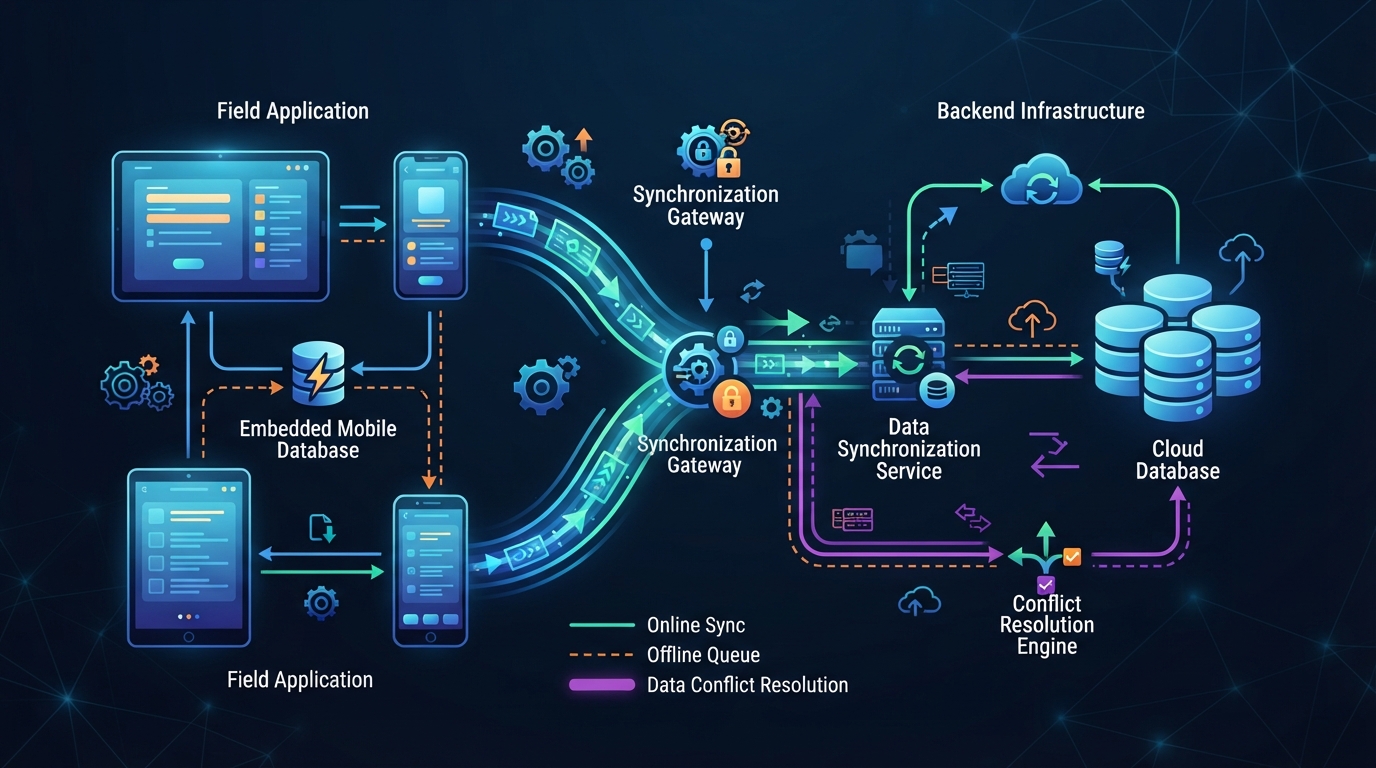
Introduction and Architecture Requirements
Field teams frequently encounter poor internet access or completely disconnected areas during their operational processes. A Web & Mobile Applications solution developed to ensure that corporate processes are not disrupted in such scenarios must be able to operate independently of network status. The cornerstone of mobile app architecture is treating network disconnections not as an exception, but as a normal condition.
Local Database and Data Storage
Data must be stored securely when there is no connection. A local database running on the device handles read and write operations at times when a connection with the server cannot be established.
- Relational or document-based local storage units should be preferred.
- Storing sensitive corporate data with encryption is mandatory for security reasons.
- Memory management must be optimized so as not to consume device resources.
Queue-Based Synchronization Strategies
When the device reconnects to the internet, local changes need to be transferred to the server. A queue-based approach is followed at this stage.
Creating an Operation Queue
Every operation performed by the field worker in offline mode (adding, updating, deleting data) is recorded in a local queue table. When network connectivity is established, this queue is processed in order.
Background Services
Background services are used to ensure that the synchronization process does not negatively affect the user experience. The user is notified when operations are completed.
Conflict Resolution
Data conflicts are inevitable when multiple workers make simultaneous changes to the same data. The following strategies can be applied to handle these situations:
- Last Write Wins: The latest change based on the timestamp is accepted as valid.
- Server Priority: The current data on the server always takes precedence.
- Manual Resolution: Providing interfaces that allow the user or manager to intervene when a conflict is detected.
Conclusion
The efficiency of field operations is directly dependent on the stability of enterprise software. A properly designed architecture enables businesses to maintain data integrity.
Hypothetical Scenario: Power Distribution Grid Maintenance
To materialize the practical counterpart of this architectural approach, let us consider an energy distribution team performing fault detection in a rural area. The field technician fills out a transformer maintenance form in a mountainous terrain with no cellular coverage and creates a new fault record. The application records this data instantly into the encrypted local storage in accordance with Web & Mobile Applications standards. The technician makes dozens of measurements throughout the day, and each operation is added to the local queue. Upon returning to the city center and entering cellular coverage, the background service automatically activates. The data in the queue is sent to the server in chronological order. During this process, it is understood that another team member made an update from the office for the same transformer, and the system triggers the manual resolution interface instead of the "Last Write Wins" rule. The operations manager compares both versions on their screen and approves the correct data. Thus, no data loss occurs, network disruptions do not stop the workflow, and field personnel continue their operations seamlessly. At the end of the process, all synchronization logs are securely closed.
Detailed Implementation Checklist
When building a robust offline-capable mobile architecture, certain steps must be fully implemented to minimize technical risks and manage failure conditions. First, it must be ensured that local database encryption keys are stored in the device's secure hardware layer (Keychain or Keystore). Second, idempotent structures (yielding the same result on repeated calls) should be preferred when designing the transaction queue mechanism, thereby preventing data pollution caused by duplicate requests of the same call under poor connections. Third, memory and disk occupancy rates should be checked periodically, and old synchronized data should be cleaned up within a secure policy framework. Fourth, in the event of network errors (HTTP 5xx, timeout, or disconnection), an exponential backoff strategy should be applied to balance the load on the server. Fifth, clear and understandable visual indicators reporting network and synchronization status should be provided to the user. Finally, all error scenarios should be tested end-to-end to ensure that the application transitions to safe mode in cases where data integrity is compromised.
References
- Web & Mobile Applications — Cy Logic Software