Multi-Branch Financial Consolidation and Exchange Rate Management in Hotel Businesses
Multi-currency reporting, hotel accounting, and exchange rate difference management steps for tourism businesses in Northern Cyprus and Turkey.
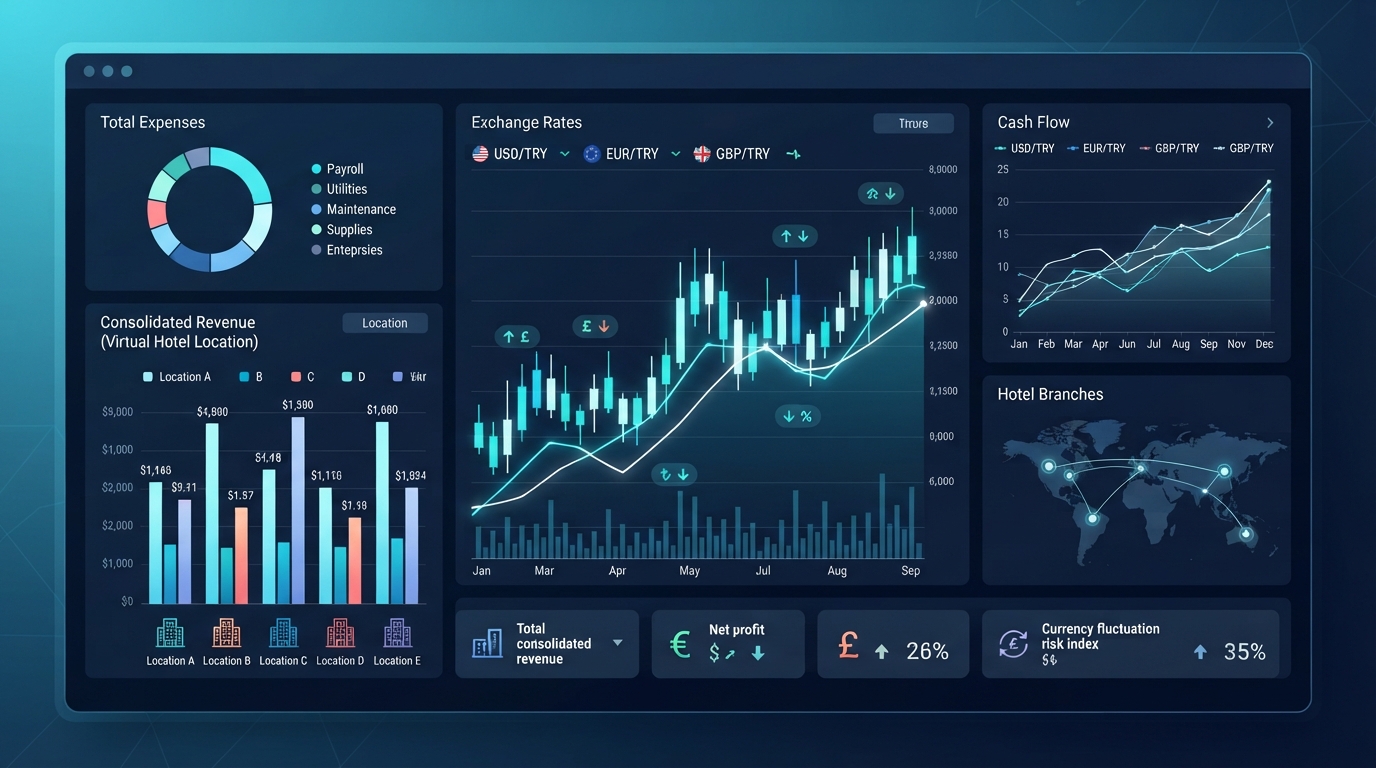
Businesses operating in the tourism and hospitality sector have to manage revenues and expenses coming from different branches and multiple currency types. Executing financial consolidation processes flawlessly is a critical technical requirement for sustainable profitability for hotel businesses in the Turkey and TRNC markets. In this guide, we will examine how data integrity can be ensured in multi-branch structures and how real-time exchange rate tracking can be integrated into operational processes.
The Importance of Multi-Currency Structures in Hotel Accounting
In the hospitality industry, reservations, food and beverage revenues, and payments from foreign tourism agencies are typically realized in different currencies. This presents a complex picture for accounting departments.
- Preventing deviations caused by different exchange rates,
- Converting daily collections and payments into a standard currency,
- Establishing a correct Finance & Accounting Systems infrastructure,
constitute the cornerstone of this process. Thanks to multi-currency reporting mechanisms, business managers can anticipate risks arising from currency fluctuations.
Steps for Financial Consolidation and Real-Time Exchange Rate Difference Management
In hotel groups with multiple properties, keeping books based on each branch's own local currency or transaction rate can create difficulties during the head office consolidation phase. Technically, this process needs to be automated.
1. Integration and Data Flow
Seamless data flow between branches is essential. Real-time synchronization must be established between front-office systems and back-office accounting modules. This ensures that revenue items are reflected in the system without delay.
2. Real-Time Currency Conversions
Using centralized finance software , current exchange rates are integrated into the system. Calculations made over the exchange rate values at the time of the transactions minimize exchange rate difference losses that may occur at period-end closings.
3. Consolidated Reporting
Financial statements of all branches are combined on a single screen. Thanks to financial consolidation processes, the board of directors can track the instant status of all facilities from a single report.
Conclusion
Digitalizing hotel accounting processes in hotel businesses and automating exchange rate difference management steps reduces the financial error margin to zero. By using software with multi-currency reporting capabilities, you can safely manage your business's cash flow.
Hypothetical Scenario: Exchange Rate Management and Consolidation of a Three-Branch Chain Hotel
In this scenario, we consider a hotel chain operating in the Mediterranean region with a total of three different facilities, including its head office. While the first branch of this chain receives long-term German tourist reservations based on Euros (EUR), the second branch transacts in US Dollars (USD), and the head office monitors all financial reporting through Turkish Lira (TRY). During sudden currency fluctuations in the mid-season, manual Excel-based data flow from the branches was delayed, and the central accounting department could not accurately calculate exchange rate difference losses. This data inconsistency led the board of directors to make incorrect profitability forecasts and budget deviations.
To solve this problem, the business transitioned to a Finance & Accounting Systems infrastructure. Following integration, all EUR and USD revenues from front-office systems were automatically converted into TRY using CBRT real-time foreign exchange selling rates. Thanks to the financial consolidation performed at the end of the period, inter-branch money transfers and foreign currency debts were valued correctly. The biggest technical trade-off encountered was that the frequency of fetching real-time exchange rates increased server load; this was optimized using a cache mechanism, preserving system performance. In terms of error management, in the event of outages in exchange rate services, the last valid rate was used, and an automatic alert was sent to the finance department.
Implementation Checklist for Multi-Branch Consolidation and Exchange Rate Management
A specific operational discipline must be followed for financial integration to be completed flawlessly in multi-branch hotel businesses. The key steps to pay attention to in this process ensure that potential risks are minimized and data integrity is guaranteed.
- Infrastructure and Integration Planning: The security and data transfer speed of API connections between branches' front-office PMS systems and finance software must be tested.
- Standardization of the Foreign Exchange Rate Source: The official exchange rate source (e.g., CBRT) to be used in all consolidation processes must be determined, and the system should be fixed to this source.
- Automatic Exchange Rate Difference Calculations: Settings for exchange rate difference management modules must be configured for the valuation of foreign currency debts and receivables.
- Authorization and Role Management: While branch managers can only view local data of their own facilities, the central finance team must have full authorization on financial consolidation screens.
- Error Management and Logging: Automatic error logging and alarm mechanisms must be activated for incompatibilities caused by API disruptions, missing exchange rate information, or incorrect currency codes.
- Periodic Reconciliations: Branch-based trial balance controls should be performed weekly and monthly to detect potential differences at an early stage.
Sources
- Finance & Accounting Systems — Cy Logic Software