Idempotency Keys and Double-Payment Architecture in System Integrations
A technical guide to preventing double payments caused by network errors and duplicate requests in financial system integrations.
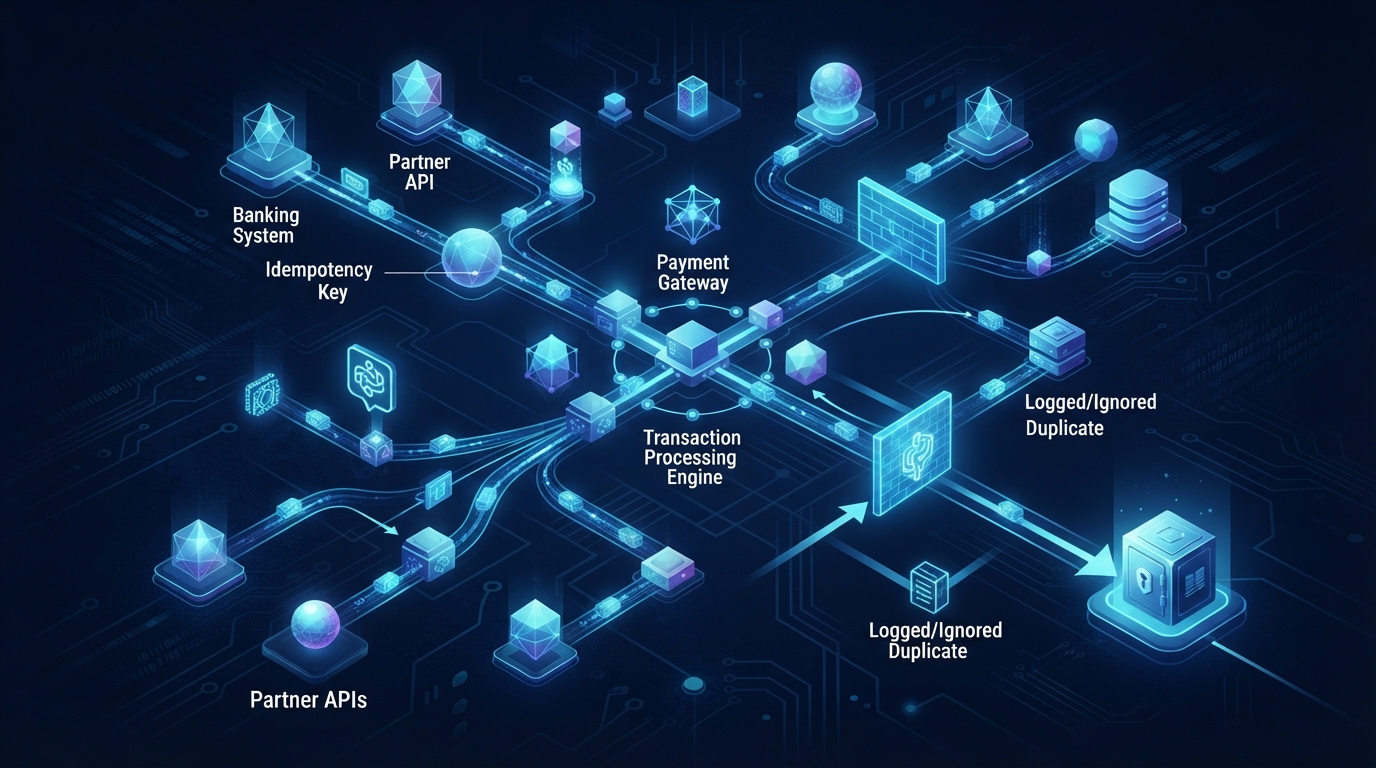
One of the most critical operational risks in financial software and e-commerce infrastructures is duplicate data flows and the triggering of the same financial transaction multiple times. Especially under poor network conditions or client-side timeout scenarios, clients tend to resend the exact same request. This situation can lead to severe costs and data inconsistencies in the background. As we address in our System Integrations processes at Cy Logic Software, mechanisms to prevent double payments are of vital importance in such scenarios.
The Concept of Idempotency and Its Core Logic
Idempotency is a mathematical and architectural principle ensuring that regardless of how many times an operation is called consecutively, the final state of the system remains the same after the first call. In the context of API security and financial software, this concept is used to prevent a payment order or transfer request from being processed twice at the network layer.
When a client sends a request to the server, it generates a unique request token (idempotency key). This key is preserved throughout the lifecycle of the request and processed at the database layer.
Database-Level Design: Solution with PostgreSQL
To establish a secure idempotency mechanism on PostgreSQL, unique constraints must be defined on the request table. The transaction steps are structured as follows:
- The client transmits the idempotency key in a custom header along with the API request.
- The server attempts to save this key into the unique column of the relevant table in the relational database.
- If the key has been saved previously, a unique violation database error is returned, and instead of initiating a new transaction, the system returns the result of the previous operation.
- If the transaction has not yet been completed, a 'processing' status is returned to block concurrent requests.
API Security and Request Management in System Integrations
Network delays are inevitable during third-party system integrations. In system integration projects, communication between services must be secure and traceable. Client-side UUID usage reduces the probability of collisions to almost zero. Within the API security layer, validity periods (TTL) for incoming keys must be determined, and outdated keys should be periodically cleaned up.
Error Management and Response Caching
In a successful double-payment prevention architecture, not only the existence of the key is checked, but the result of the initial request (successful or error response body) must also be stored. When a duplicate request arrives, the system:
- Directly returns the response of the first request if the operation has already succeeded.
- Reflects the exact same error if the operation failed, ensuring the client sees a consistent state.
These architectural approaches protect data integrity across financial software while proactively preventing potential disaster scenarios during system integration processes.
Hypothetical Working Scenario: Payment Gateway Integration
Let us assume an e-commerce platform is integrated with a third-party payment provider. When the customer clicks the "Complete Payment" button, a UUID-based idempotency key is generated on the client side, and this key is appended to the payment request header. Due to a poor mobile connection, the client receives a timeout response from the payment server, but the payment has actually been processed successfully in the financial network. Detecting the network error, the client automatically re-triggers the exact same request using the exact same idempotency key.
In this scenario, the API gateway in the background receives the request and executes the unique constraint check in the database. The system detects that the relevant key was processed just moments ago and that the payment was even completed. Instead of acquiring a new bank authorization, it instantly returns the first successful transaction response cached in the database to the client. Thus, charging the customer's card a second time is prevented. The largest trade-off encountered in this process is a slight increase in database write cost; however, this cost is negligible compared to the financial and operational damages a potential double payment would cause. For failed requests, the status code and details of the error are stored, transmitting a consistent error message to the client.
Idempotency and Double-Payment Architecture Implementation Checklist
To establish a secure idempotency mechanism in system integrations and manage potential error scenarios, the following steps must be fully implemented:
- Client-Side UUID: Ensure that a unique UUID is generated on the client side for every new financial transaction, eliminating the possibility of collisions.
- Database Uniqueness: Define a 'UNIQUE' constraint on the idempotency key column in PostgreSQL or similar relational databases.
- Concurrency Locking: Actively use database row-level locks or 'processing' status flags to prevent simultaneously arriving duplicate requests.
- Response Caching: Store the HTTP status code and response body belonging to the first request in a secure table, and return this response directly for duplicate requests.
- TTL and Cleanup: Establish a Time-To-Live (TTL) for old idempotency keys to prevent database bloat, and run periodic cron jobs for cleanup.
- Network Timeout Management: Optimize timeout durations between the client and server, and configure retry policies in alignment with idempotency rules during error conditions.
This structure maximizes data integrity during system integration processes while providing a seamless financial flow in compliance with the System Integrations standards offered by Cy Logic Software.
Sources
- System Integrations — Cy Logic Software