Event-Driven Architecture and Bidirectional Data Synchronization in System Integrations
We examine the setup of event-driven architecture and asynchronous data flow to prevent delays between ERP, finance, and inventory systems in businesses.
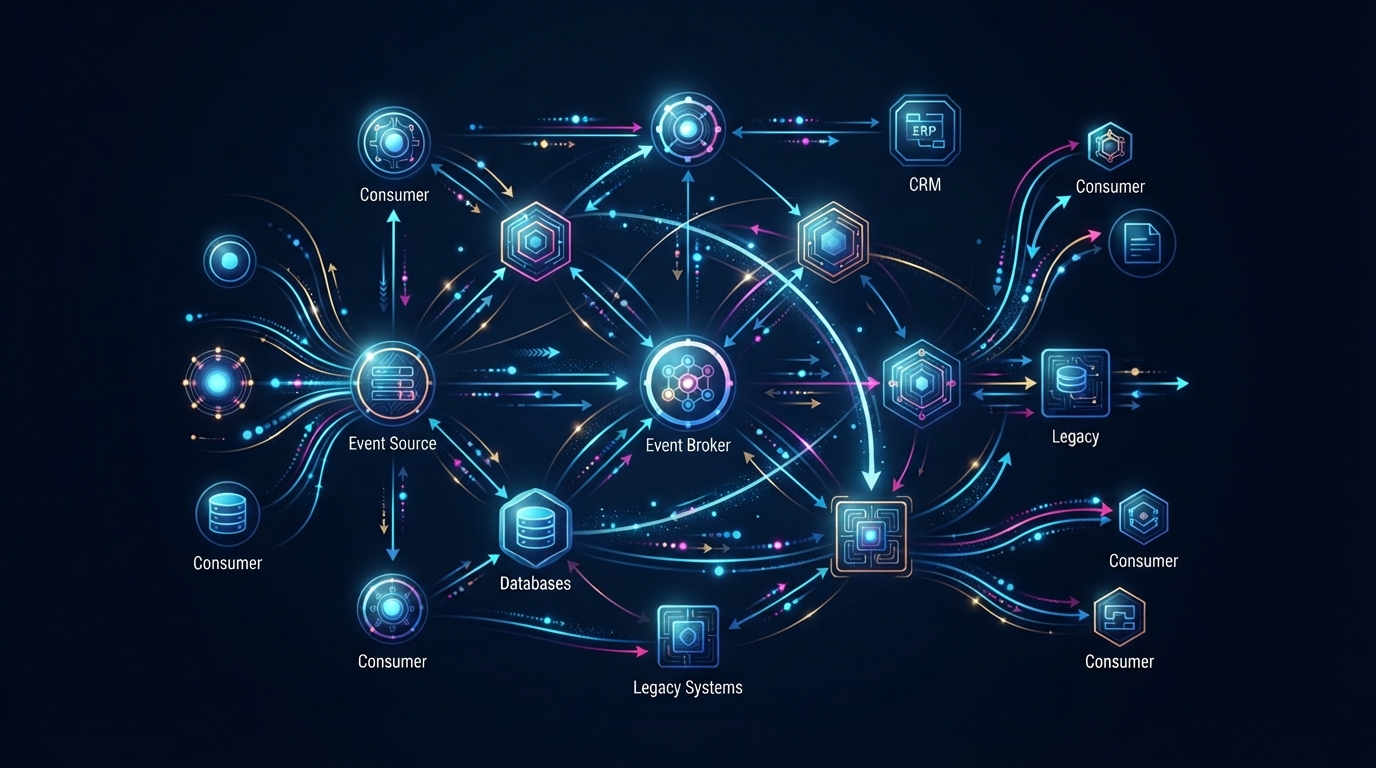
Introduction and Core Concepts
The seamless operation of enterprise resource planning, finance, and inventory software used in modern businesses is critically important for operational continuity. These software solutions, utilized by different departments, need to feed each other without delays. Structures examined under the title of System Integrations ensure reliable data flow between ERP, accounting, payment, SMS, e-mail, and third-party systems.
Setting Up Event-Driven Architecture (EDA)
Classic point-to-point integrations become unmanageable as systems grow. This is where event-driven architecture comes into play. A critical change occurring in a system (for example, creating a new order or changing inventory quantity) is written to the queue as an event.
- Thanks to the asynchronous flow, the producer system does not have to wait for the response of the consumer system.
- Message queues prevent data loss even under load and support independent system operations.
Bidirectional Data Synchronization and Conflict Resolution
While performing bidirectional data synchronization between different platforms, simultaneous changes may occur on the same data. This situation can lead to data inconsistencies. For a robust system integration, the following steps should be followed:
- Chronological ordering of events.
- Timestamp or version number control.
- Determining automated conflict resolution strategies (e.g., last write wins or manual approval queue).
Practical Decision Criteria
When designing an integration project, the system's volume, instant data transfer requirements, and fault tolerance must be taken into consideration. Asynchronous flows may not be suitable for every scenario; synchronous middleware may be required in points requiring instant consistency, such as financial reconciliation.
Hypothetical Scenario and Sample Application Flow
To materialize this theoretical structure, let us consider a medium-sized retail enterprise operating internationally and conducting e-commerce and physical retail together. This business uses special cloud-based software for order management and a traditional ERP system for pre-accounting and finance operations. When a customer orders a product through the website, the cloud-based order management system produces an "order_created" event and fires it to the message queue. The ERP system consumes this message, reduces the relevant inventory amount, and prepares the invoice. The biggest architectural gain in this scenario is that even if there is an instantaneous slowdown or outage in the payment or accounting system, the e-commerce site continues to receive orders uninterruptedly. Data securely held in the message queue is processed sequentially as soon as the systems are back up. However, there is a critical trade-off to consider during this flow: While the asynchronous structure significantly increases system response time and scalability, it requires sacrificing instantaneous consistency. A delay of a few seconds until the consumer system processes the message may create a risk of data inconsistency in business processes where tolerance is impossible. In such cases, alongside the event-driven architecture, compensating transactions should be designed for critical financial steps, and automatic rollback mechanisms should be activated in case of failure.
Detailed Implementation and Success Checklist
Before launching a robust and sustainable integration project into production, technical teams must meticulously complete the following steps. First, it must be ensured that a "Dead Letter Queue" architecture is established within the message queue setup. Messages that cannot be processed or throw errors should be directed to this queue instead of entering an infinite loop, and should generate alarms for operational teams. Second, clock synchronization between systems must absolutely be performed using the Network Time Protocol. When timestamp-based conflict resolution strategies are applied, even millisecond-level clock drifts between servers can cause the last-write-wins rule to malfunction and overwrite current data. Third, schema versioning of all payload data must be performed, and adapter layers must be written to manage incompatibilities between old and new versions. In the fourth step, distributed logging systems must be integrated for end-to-end traceability, and a unique correlation ID must be assigned to each event. When this checklist is applied completely, system integrations become resilient against potential network outages, load spikes, and data conflicts, allowing business operations to continue safely without any disruptions.
References
- System Integrations — Cy Logic Software