Distributed Transactions and Data Consistency in Microservices Architecture
We examine the two-phase commit and outbox pattern to ensure data consistency in financial software migrating to a microservices architecture.
Introduction and Architectural Transformation
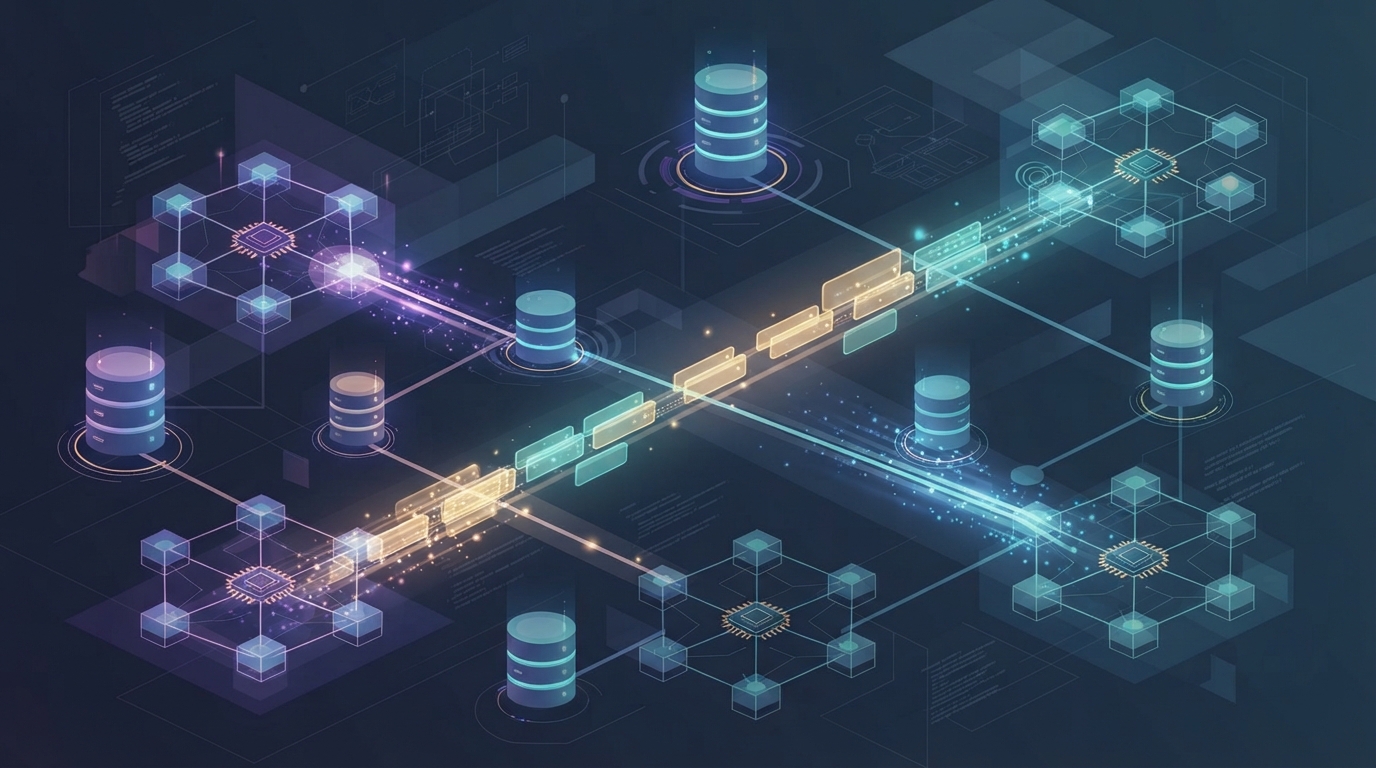
Enterprise organizations are transitioning from monolithic structures to a microservices architecture approach to make business processes scalable. Decoupling critical modules such as Finance & Accounting Systems provides fault isolation while introducing new technical challenges in the context of distributed transactions.
Core Challenges in Distributed Transactions
Within a microservices architecture, having a dedicated database for each service prevents traditional ACID principles from operating within a single transaction boundary. When a payment order is issued, both the general ledger must be updated and the balance of the relevant current account must be deducted. Coordinating these processes across different services leaves them vulnerable to data consistency violations.
Two-Phase Commit (2PC) Protocol
One of the classic methods used to maintain atomicity in distributed systems is the two-phase commit mechanism. This protocol consists of two phases:
- Prepare Phase: The coordinator service asks all participant services whether the transaction can be completed. Participants lock resources and report that they are ready.
- Commit Phase: If approval is received from all services, the transaction is made permanent; otherwise, all changes are rolled back.
2PC Disadvantages
Financial software requires high concurrency. The 2PC protocol can lead to performance bottlenecks across the system due to locking durations and network delays. In the event of a coordinator service crash, the participant services remaining locked poses a major risk factor.
Asynchronous Approach with the Outbox Pattern
The outbox pattern is an asynchronous solution designed to eliminate the locking costs introduced by the two-phase commit protocol. In this model, the main database transaction and the event to be dispatched are written to the outbox table within the same local transaction.
Outbox Workflow Steps
- Local Transaction: The service applies the business rule in its own database and inserts a message record into the outbox table within the same transaction.
- Event Transmission: A separate process (a background poller or a CDC - Change Data Capture tool) reads unread records from the outbox table and delivers them to the Message Broker.
- Cleanup: Successfully delivered messages are deleted or marked in the outbox table.
Choosing the Right Approach
When designing distributed transactions, the business requirements of the system must be rigorously analyzed. While prescriptive protocols are evaluated in narrow scopes requiring strict real-time synchronization, the outbox pattern, which provides eventual consistency, offers a safer alternative in financial software projects where performance and scalability are paramount.
Hypothetical Working Example: E-Commerce Payment Flow
In our scenario, let us assume that a customer makes a payment through an order module integrated into the Finance & Accounting Systems infrastructure. After creating the order, the order service sends a request to the payment service, and the accounting service processes the revenue entry. Database locks are prevented in this process by using the Outbox pattern. While writing data to the orders table, the order service also appends an 'OrderCreated' event to the Outbox table within the same transaction block. A Change Data Capture (CDC) mechanism running in the background continuously scans this table and transfers new records to a message queue such as Kafka or RabbitMQ. The payment service consumes this message and performs its balance deduction operation. If the payment service temporarily becomes unreachable, the data waiting in the message queue does not lock the system; instead, the queue mechanism activates retry policies. Thus, while the system gains resilience against instantaneous network outages or service downtimes, all services reach the current state of the data in a synchronized manner due to the eventual consistency principle. Although this architecture increases operational load, it optimizes the system response time even under high traffic.
Detailed Implementation Checklist and Error Management
To establish a stable structure in distributed architectures, the flawless implementation of specific engineering steps is mandatory. First, an Idempotency mechanism must be designed into database operations. Against the possibility of the same event arriving multiple times from message queues, each processed transaction must be controlled with a unique key. Second, safely deleting or marking messages read from the Outbox table as 'processed' after queue delivery prevents data duplication. In the error management phase, a Dead Letter Queue (DLQ) structure should be established; messages failing sequential retries must be gathered here and subjected to manual review. System administrators should monitor latency times and queue sizes in real time for these processes, which are critical for financial software. Furthermore, the applicability of the SAGA pattern should be evaluated for compensating transactions, and circuit breaker libraries should be integrated for network partition and timeout scenarios. This checklist minimizes the risk of losing data during distributed transactions.
Resources
- Finance & Accounting Systems — Cy Logic Software