Database Sharing Issues and Solutions in the Transition to Microservices Architecture
We examine the database sharing problems and data integrity challenges experienced during the transition from monolithic systems to microservices through technical steps.
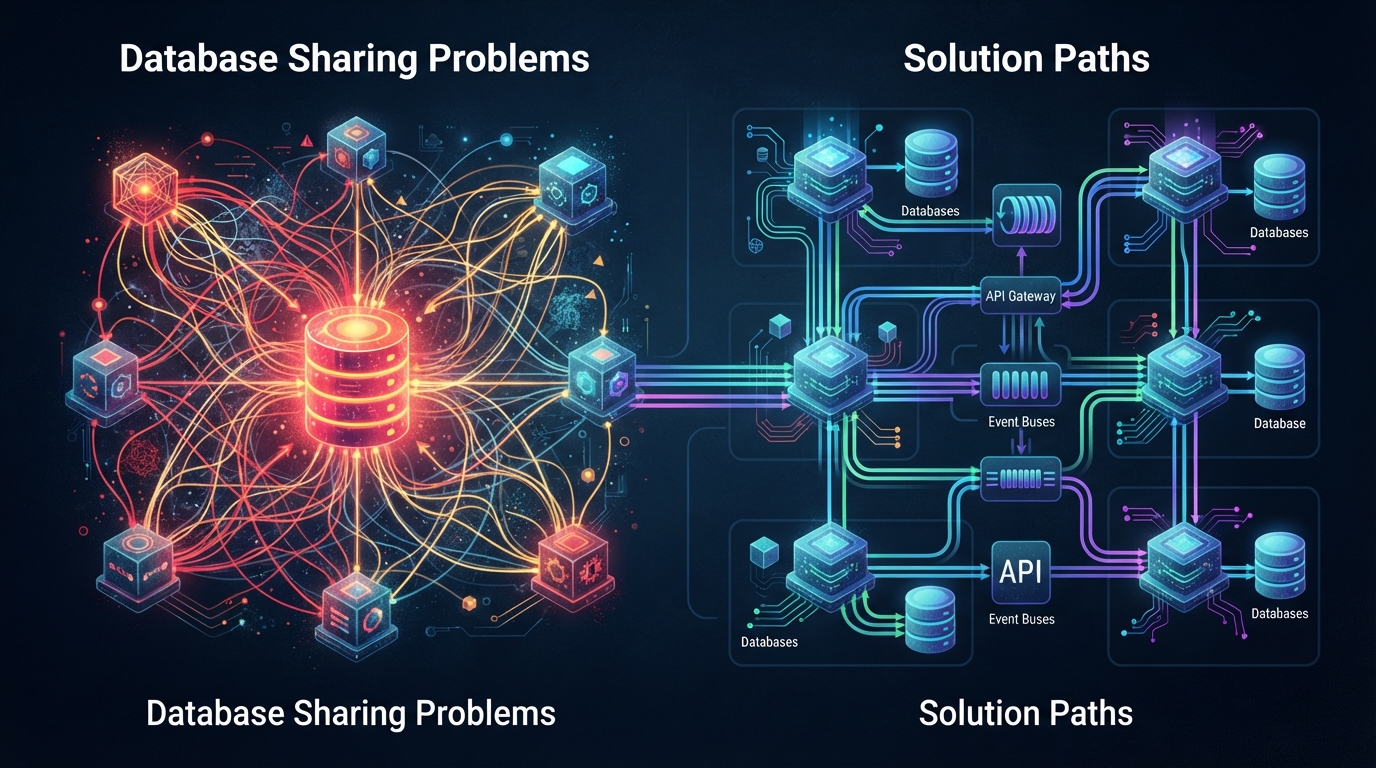
The transition from monolithic structures to modern architectures is a critical milestone for businesses. Especially in Enterprise Software & ERP projects, managing multiple departments and processes under the same roof requires meticulous attention to the technical infrastructure. One of the fundamental challenges encountered when stepping into the world of distributed systems is the database architecture design and service data access models.
Shared Database Anti-Pattern and Risks
The first trap that teams evolving from monolithic systems to microservices structures fall into is continuing to share the same database across all services. Although this approach provides short-term convenience, it completely violates the principles of distributed systems in the long run.
- Tight Coupling: Inter-service dependency does not decrease; on the contrary, it increases at the database level.
- Scalability Barrier: Services under different loads compete for the same database resources.
- Schema Change Conflicts: A table update in one service can break the code of other services.
Strategies for Preserving Data Integrity
Each microservice having its own database (Database-per-Service) complicates data integrity management. Operations move beyond the boundaries of a single ACID transaction into distributed structures.
Saga Pattern Implementation
The Saga pattern is used to manage processes formed by the combination of local transactions in distributed systems. This approach can be implemented using two different methods:
- Choreography: Services listen to each other's events, trigger their own local operations, and advance the process.
- Orchestration: A central service (saga orchestrator) controls the order of all steps and initiates compensating operations in case of potential errors.
CQRS and Event-Driven Architecture
In complex enterprise software scenarios, separating read and write operations is essential for performance. Thanks to the Command Query Responsibility Segregation (CQRS) pattern, data changes are asynchronously shared with other services. Thus, the database architecture can easily handle different workloads.
Step-by-Step Migration Roadmap
To successfully complete the transition process safely, the following steps should be followed:
- Domain Modeling: Divide business processes into correct bounded context boundaries.
- Data Separation: Migrate tables in the shared database piece by piece according to the respective microservice responsibilities.
- Asynchronous Synchronization: Use reliable message brokers to resolve data inconsistencies between services.
Hypothetical Scenario: Order and Inventory Integration
While addressing this theoretical scenario, let's examine the separation of order and inventory services in an e-commerce-based enterprise architecture. In the monolithic structure, when an order was created, the inventory table was updated directly. During the microservice transformation, these two domains were separated and each service's own database was designed. When a user places an order, the Order Service writes the new record to its own database and fires an OrderCreated event. The Inventory Service listens to this event and decreases the quantity in its own database. However, a critical trade-off emerges here: Eventual consistency is accepted instead of strong consistency. If the Inventory Service cannot respond due to a network outage or message queue errors, the order table and inventory table will temporarily mismatch. Compensating transactions are initiated to manage this error. If stock remains insufficient, the saga orchestrator sends a compensation command to cancel the order. During the error management phase, dead-letter queue mechanisms are established so that unprocessable messages are logged and system administrators are given the opportunity for manual intervention.
Detailed Migration and Implementation Checklist
To manage the transition process from database sharing to isolated microservice databases without risk, a checklist consisting of specific steps must be implemented. In the first phase, the bounded context of each service must be defined with sharp lines, and direct database join queries between services must be completely eliminated. In the second phase, while the ownership of shared tables is transferred to a single service, API or CQRS-based projection layers should be created for read-only access to this data by other services. In the third phase, dual-write or Change Data Capture (CDC) tools are integrated into the project to keep downtime to a minimum during data migration. In the fourth phase, failure scenarios of distributed transactions are simulated end-to-end and subjected to load tests. The biggest failure encountered in this process is the duplicate processing of messages in asynchronous flows. To prevent this, idempotent consumer designs must be included in the code base. In the final phase, all system metrics are scrutinized using monitoring tools, and performance bottlenecks are resolved.
Sources
- Enterprise Software & ERP — Cy Logic Software