Cost Accounting and ERP Integration in Manufacturing Enterprises
Technical guide on cost accounting processes in manufacturing enterprises, comparison of actual and standard costs, and ERP integration.
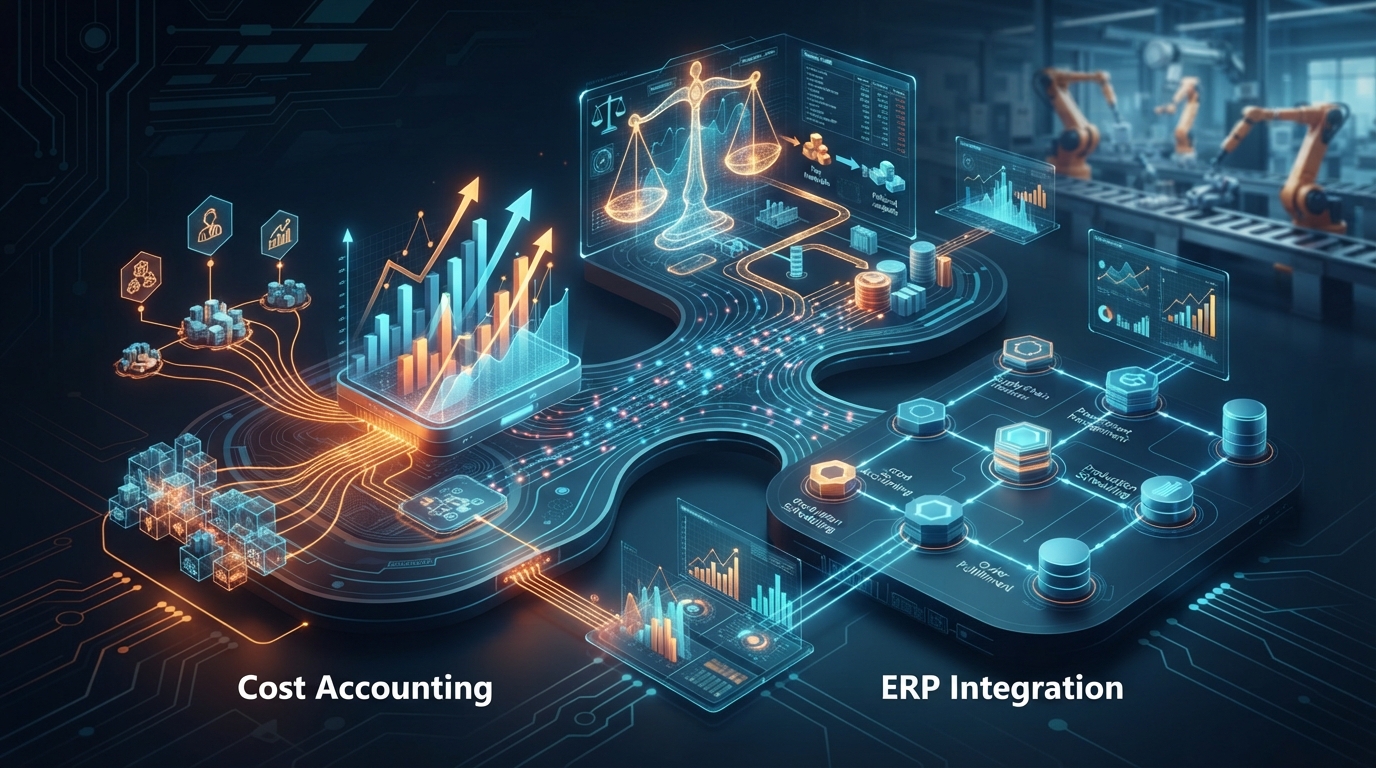
Cost Accounting and ERP Infrastructure in Manufacturing Enterprises
Accurately calculating order costs in production and logistics-focused enterprises is of critical importance for the sustainability of corporate processes. In this context, Enterprise Software & ERP solutions offer dedicated structures that manage multiple departments and companies under the same digital roof. Automating cost accounting processes allows businesses to track financial data instantly.
Standard Cost and Variance Analysis
Standard cost, defined within manufacturing software, is calculated based on projected raw material consumption, labor hours, and general manufacturing overheads. Once manufacturing operations are completed, businesses analyze the differences between standard costs and actual values. This process is reported without errors thanks to the data flow provided by the Enterprise Software & ERP infrastructure.
Actual Cost Tracking and Data Architecture
Actual cost reflects the cost of real resources consumed during production. The instant transfer of material consumption and labor hours to the Enterprise Software & ERP system increases the accuracy of cost accounting. A correct data architecture decision ensures that operational efficiency is accurately reflected in financial statements.
## Hypothetical Scenario: Automotive Sub-Industry Application Let's assume brake discs are manufactured in an automotive sub-industry enterprise. In this scenario, let's examine how variances between standard cost-based planning and actual production results are monitored through the Enterprise Software & ERP system. When a production order is opened, cast iron as raw material and labor hours are entered into the system with projected values. However, during operations, a seven percent increase in scrap occurs in cast iron consumption due to fluctuations in supplier quality, and labor times are prolonged. Instead of manually calculating such negative variances at the end of the month, the enterprise notices them immediately thanks to the instant data flow provided by the Enterprise Software & ERP infrastructure. In terms of error management, raw material lot tracking is used to monitor which supplier batch caused the increase in scrap. Consequently, the board of directors takes instant measures to prevent costs from eroding profitability and swiftly implements operational decisions based on data.Implementation Checklist for ERP Integration and Cost Accounting
There are critical steps to follow when integrating cost accounting processes into the Enterprise Software & ERP system in manufacturing enterprises. First, workstations and operation routes must be fully defined. Deficiencies in data architecture can lead to labor hours being reflected in incorrect cost centers. Second, material stock movements and work order closing discipline must be applied uncompromisingly; unclosed work orders disrupt actual cost calculations. In the third phase, choosing the correct general manufacturing overhead distribution key is of vital importance. Incorrect distribution keys can completely mislead product-based profitability analyses. In the fourth step, authorization and error management protocols must be established. Approval mechanisms should be activated to prevent user errors that may occur during stock issues or recipe variances. Finally, system reports must be audited regularly, and periodic reconciliations between the accounting department and production engineering must be conducted to keep data integrity at the highest level at all times. ## Hypothetical Scenario: Automotive Sub-Industry Application Let's assume brake discs are manufactured in an automotive sub-industry enterprise. In this scenario, let's examine how variances between standard cost-based planning and actual production results are monitored through the Enterprise Software & ERP system. When a production order is opened, cast iron as raw material and labor hours are entered into the system with projected values. However, during operations, a seven percent increase in scrap occurs in cast iron consumption due to fluctuations in supplier quality, and labor times are prolonged. Instead of manually calculating such negative variances at the end of the month, the enterprise notices them immediately thanks to the instant data flow provided by the Enterprise Software & ERP infrastructure. In terms of error management, raw material lot tracking is used to monitor which supplier batch caused the increase in scrap. Consequently, the board of directors takes instant measures to prevent costs from eroding profitability and swiftly implements operational decisions based on data.Implementation Checklist for ERP Integration and Cost Accounting
There are critical steps to follow when integrating cost accounting processes into the Enterprise Software & ERP system in manufacturing enterprises. First, workstations and operation routes must be fully defined. Deficiencies in data architecture can lead to labor hours being reflected in incorrect cost centers. Second, material stock movements and work order closing discipline must be applied uncompromisingly; unclosed work orders disrupt actual cost calculations. In the third phase, choosing the correct general manufacturing overhead distribution key is of vital importance. Incorrect distribution keys can completely mislead product-based profitability analyses. In the fourth step, authorization and error management protocols must be established. Approval mechanisms should be activated to prevent user errors that may occur during stock issues or recipe variances. Finally, system reports must be audited regularly, and periodic reconciliations between the accounting department and production engineering must be conducted to keep data integrity at the highest level at all times.Sources
- Enterprise Software & ERP — Cy Logic Software