Bill of Materials (BOM) Revision Management and ERP Database Design in Manufacturing Enterprises
Explore how frequently changing Bill of Materials (BOM) versions in manufacturing enterprises should be modeled in ERP systems without compromising data integrity.
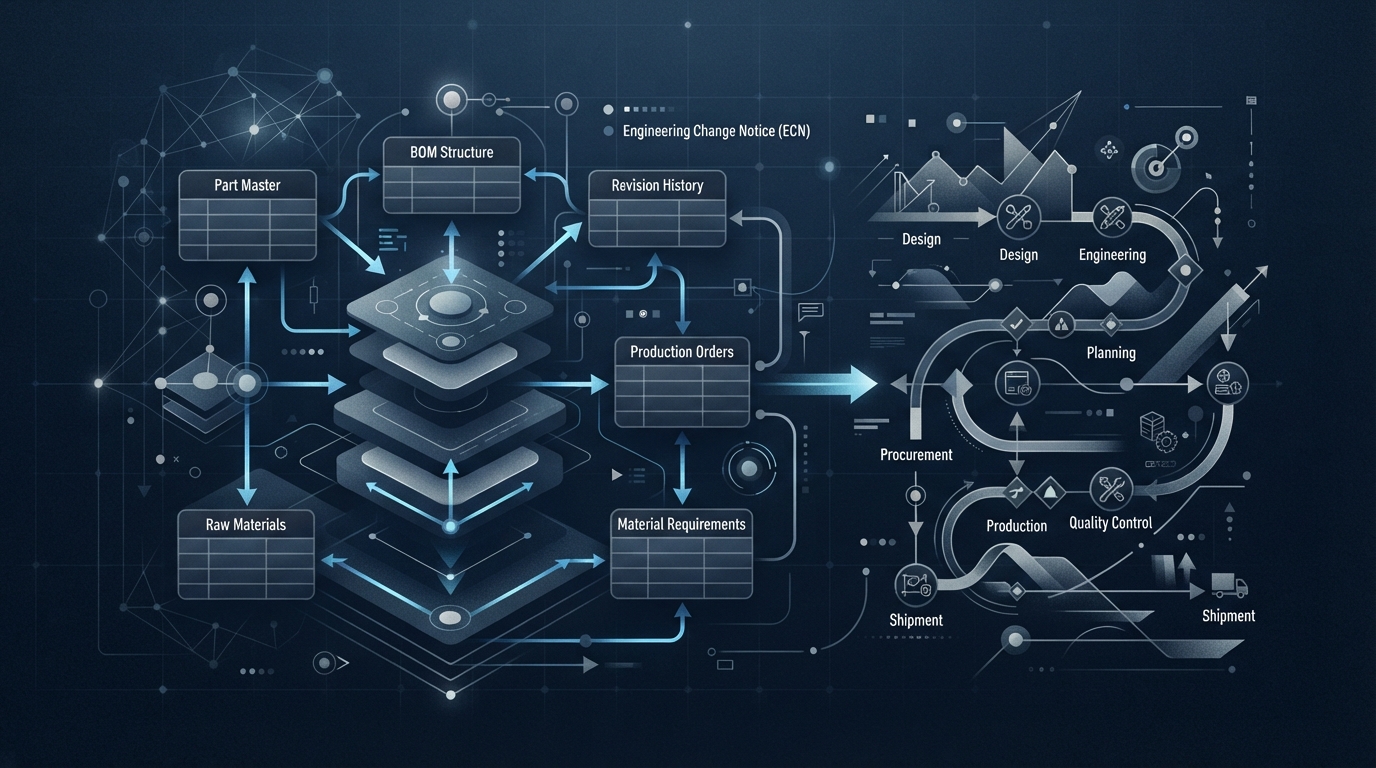
One of the most critical components of engineering and manufacturing processes in production enterprises is Bill of Materials (BOM) management. In environments where product features, raw material changes, and technological innovations are frequently updated, revision management requires great technical precision. In this guide, we will examine the impact of Bill of Materials revisions on cost calculations and how data integrity is ensured in Enterprise Software & ERP infrastructures.
Bill of Materials and the Need for Versioning
The BOM, which is a hierarchical list of materials, components, and sub-assemblies required to manufacture a product, can change over time due to engineering change orders (ECO). If these changes are not tracked, the following technical problems occur:
- The cost of a finished product manufactured in the past cannot be calculated accurately.
- The purchasing department may place incorrect raw material orders.
- Faulty components may be assembled on the production line.
Therefore, it is essential that each revision is labeled with a version number or a validity date range.
Database Design Approaches in ERP Systems
Relational modeling principles must be considered in ERP database design to preserve data integrity and retain historical traceability. The following elements should be taken into account when designing the table architecture:
1. Separation of Master BOM and Revision Tables
The master table holding the header information of the bill of materials (product code, creator, description) must be separated from the detail table holding the components and quantities. For revision management, a Revision_ID or Valid_From / Valid_To date columns should be added to the detail table.
2. Time Dimension in Cost Calculations
Production costs must be calculated based on the raw material prices at the time the bill of materials was valid. In Enterprise Software & ERP infrastructures, cost analyses for past orders must fetch the BOM version of that specific moment from the database. This prevents cost deviations and inconsistencies.
Implementation Steps in Production Management
- Engineering Change Process: Design changes must not be written directly onto the existing bill of materials, but rather defined in the system with a new revision number.
- Validity Check: When a production order is opened, it should be determined by rule sets depending on the user or the order whether the system will base its operation on the currently active revision or a special revision.
- Inventory Integration: Stock routing rules must be defined in the system to consume remaining alternative materials belonging to old revisions.
A Hypothetical Scenario: Revision Management Implementation for the Automotive Supplier Industry
Let us consider a production line manufacturing steering wheels in a medium-sized automotive supplier enterprise. For the main product with the code X-100 used on this line, a raw material change was made in the plastic injection component in line with customer demand. The engineering department implements the Engineering Change Order (ECO) procedure instead of updating the existing bill of materials directly and creates Revision B. The main commercial and technical trade-off encountered at this stage is optimizing the scrap cost of the old raw materials belonging to Revision A in the warehouse against the risk of downtime that may occur on the production line. If the system does not allow old inventories to be consumed, a high scrap cost arises; otherwise, the risk of faulty assembly increases. The ERP database design comes into play at this point by making it mandatory to determine which serial-numbered finished product will be produced with which BOM revision when creating a production order. In error management scenarios, when the operator scans a material with the wrong revision, the system automatically applies a block and requires quality assurance approval. Thus, while historical traceability is ensured, the enterprise successfully passes customer audits thanks to the data consistency provided by the Enterprise Software & ERP infrastructure.
Detailed Implementation and Integration Checklist
To successfully commission and sustain bill of materials revision management, the steps that technical teams and Enterprise Software & ERP consultants must jointly follow are as follows:
- Authorization Matrix: Permissions for creating, approving, and deactivating bills of materials should be defined exclusively for engineering managers, while production and planning departments should be given read-only access.
- Timestamp Validation: Triggers at the database level should be configured to ensure that validity date ranges (Valid_From and Valid_To) do not overlap.
- Cost Simulation: Before a new revision is activated, a simulation must be run with alternative routes and raw material prices, and its impact on unit cost must be reported.
- Stock Liquidation Rules: Automatic warning mechanisms should be established for the remaining balances of old revision components, and cross-matchings should be made for the use of these components in alternative products.
- Integration Tests: It must be tested through end-to-end scenarios whether purchasing and sales order screens correctly fetch the currently active revision data.
- Error Management and Logging: Audit log tables that record who made bill of materials changes, when, and with what justification must be kept active.
Sources
- Enterprise Software & ERP — Cy Logic Software